Traces of Ecstasy | Lagos Biennial Fourth Edition

Traces of Ecstasy is a transatlantic curatorial and research project (consisting of an architectural pavilion, an art exhibition, and a symposium) that premiered at the 2024 Lagos Biennial from February 3-10, 2024.
Traces of Ecstasy was one among a series of autonomous platforms responding in diverse ways to the biennial’s overarching theme of refuge. This edition of the Lagos Biennial was held in Tafawa Balewa Square—a site in central Lagos, named after Nigeria’s first prime minister, that hosted the country’s independence ceremonies in 1960. The curatorial project critically responded to the charged historical residues of this space, taking its constitutive role in postcolonial nation-building as a point of departure. Bridging anarchist, indigenous, queer, and critical technological paradigms, Traces of Ecstasy aims to unsettle the colonial capitalist power structures that maintain and reproduce the ideological legitimacy of the nation-state model in post/neo-colonial Africa.
Providing a space for critique, repair, and freedom-dreaming, Traces of Ecstasy featured artists from the African continent and its diasporas including Nolan Oswald Dennis, Evan Ifekoya, Raymond Pinto, Temitayo Shonibare, and Adeju Thompson/Lagos Space Programme. The exhibition presented works spanning sculpture, video, sound, textile, performance, and digital art.
Traces of Ecstasy was presented as a second, reimagined iteration at the Institute for Contemporary Art at Virginia Commonwealth University (ICA at VCU) in Richmond, Virginia from February 16 - July 14, 2024. This diasporic recursion of the project across the Atlantic not only reflected on the structural violence that permeates the African postcolony but additionally considered the historically significant oceanic distance connecting the exhibition’s two sites in Lagos and Richmond.
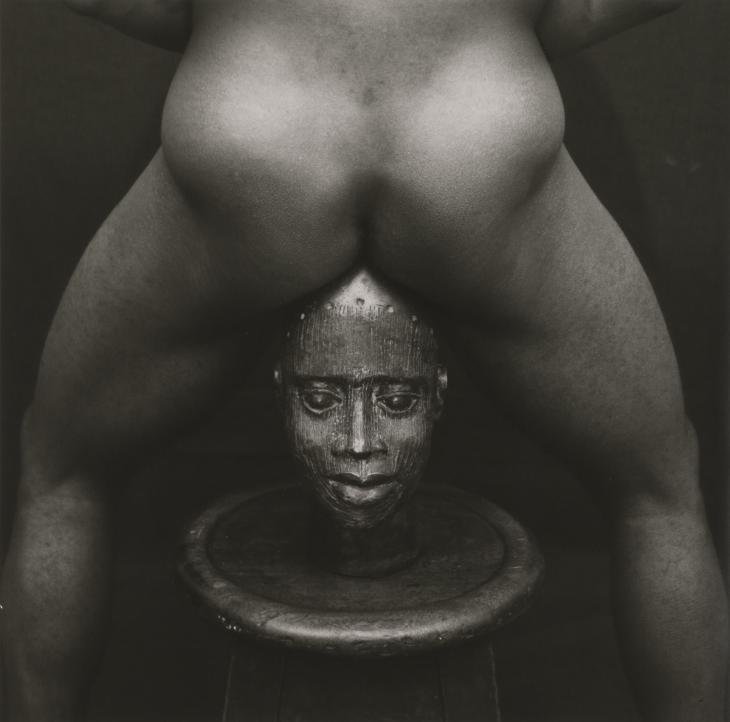
Traces of Ecstasy is titled after an essay by Rotimi Fani-Kayode, an exiled British-Nigerian artist whose photographic works combined Yoruba ritualistic practice and transgressive homoeroticism to destabilise colonial fictions of nationality and positivist rationality. Equally oriented toward a future horizon of queer, decolonial liberation, Traces of Ecstasy brings together aesthetic and discursive interventions across space and time to illuminate alternative, anarchic forms of African collectivity for the twenty-first century.
Traces of Ecstasy Symposium
Gathering artists, writers, and scholars whose works have informed the theoretical thrust of Traces of Ecstasy, the accompanying symposium (on February 7th from 12-5pm) included presentations and discussions exploring a variety of relevant themes such as the fraught relationship between colonial modernity and African indigeneity; the pitfalls of postcolonial statecraft; the intersections of critical African studies and queer and feminist theory; and the affinities between African metaphysical schemes and digital technologies.
February 7, 2024 | 12-5pm
Alliance Française de Lagos / Mike Adenuga Centre, 9 Osborne Road, Ikoyi
Featuring speakers:
KJ Abudu - Introduction
Emmanuel Iduma - “A Reckoning with Silence, Inheritance and History”
Zoé Samudzi - “Postcolonial Horror, Haunted States”
Roberto Strongman - “Transcorporeality in Afro-Hispanic Religion”
Neema Githere - “Afropresentism: Journeying through the Age of Total Recall”
Nolan Oswald Dennis - “UBU~NTU: Architectural and Virtual Spatialities of Being-Becoming”
Exhibition materials
The exhibition guidebook can be viewed here
Information on the pavilion and each of the featured works has also been included below

Traces of Ecstasy Pavilion, Lagos Biennial 2024, installation view. Photograph by Amanda Iheme.

Traces of Ecstasy Pavilion, Lagos Biennial 2024, installation view. Photograph by Amanda Iheme.

Traces of Ecstasy Pavilion, Lagos Biennial 2024, installation view. Photograph by Amanda Iheme.
Designed by Dennis, the pavilion’s modular structure and overlapping curvilinear facades referenced the recursive, fractal geometries of African indigenous space-making practices as well as contemporary makeshift architectures, both mimicking and opposing elements of the charged, haunted venue of Tafawa Balewa Square. Composed of concrete blocks, which were aligned with wooden supports to form a breeze-block pattern, the pavilion’s facades further alluded to postcolonial modernist buildings constructed during the mid-twentieth century African decolonization movements, many of which are located near the biennial’s Lagos Island location. The built structure hosted all the commissioned artworks and performances by the other invited artists and offered a space of refuge—from the sun, from the surveilling gazes of external observers, and from real or symbolic authorities (such as the head of state whose seat has a panoptic view of the square). As a sculptural composite of past, present, and future spatial grammars—one whose modular, fractal structure suggested the possibility of alternative arrangements and indeterminate repetitions—the pavilion simultaneously spurred critical engagements with and liberatory speculations beyond the colonial, post-independence, and neocolonial structures that pervade the surrounding site.
The pavilion also featured a new sound installation by Ifekoya. Emitted from dispersed dried gourd speakers, the score mixed sounds of water undergoing various state changes with Tafawa Abubakar Balewa’s independence speech, Yoruba polyrhythmic drumming, social commentary on the current state of things by working-class Nigerians, and the artist’s self-spoken narrations on healing and self-knowing through travels to the Atlantic shore in Badagry and the sacred Osun grove in Osogbo. The work metaphorically speculates on the melting, liquefaction, and sublimation of the postcolonial nation-state. The poeticization of water’s resistance to material and geographical fixity further alludes to queer modalities that destabilize structures of national, gender, sexual, and ethnic identification.

Evan Ifekoya, Three States of Water: The Flood, 2023. Sound installation (stereo sound), dried gourds, speakers, subwoofer. Dimensions variable. Photograph by Amanda Iheme.

Traces of Ecstasy Pavilion, Lagos Biennial 2024, installation view. Photograph by Amanda Iheme.
Viewers additionally encountered a series of monumental textiles by Thompson, founder of the experimental, gender-expansive fashion label, Lagos Space Programme. Continuing their formal innovations in àdìrẹ—a resist indigo-dyeing technique long practiced by the Yoruba in what is today southwestern Nigeria—the textiles’ aerial suspension, evoking market tarps and ephemeral architectures for refuge, provided a sense of protection and communal gathering for viewers’ bodies. Thompson also rips, tears, and folds the works’ surfaces, these violent gestures suggesting the scarred, brutalized skin of the postcolonial African body politic.

Traces of Ecstasy Pavilion, Lagos Biennial 2024, installation view. Photograph by Amanda Iheme.

Adeju Thompson/Lagos Space Programme, Aerial Proposition III (Post-àdìrẹ), 2024. Indigo-dyed textiles. Photograph by Amanda Iheme.

Adeju Thompson/Lagos Space Programme, Aerial Proposition III (Post-àdìrẹ), 2024. Indigo-dyed textiles. Photograph by Amanda Iheme.
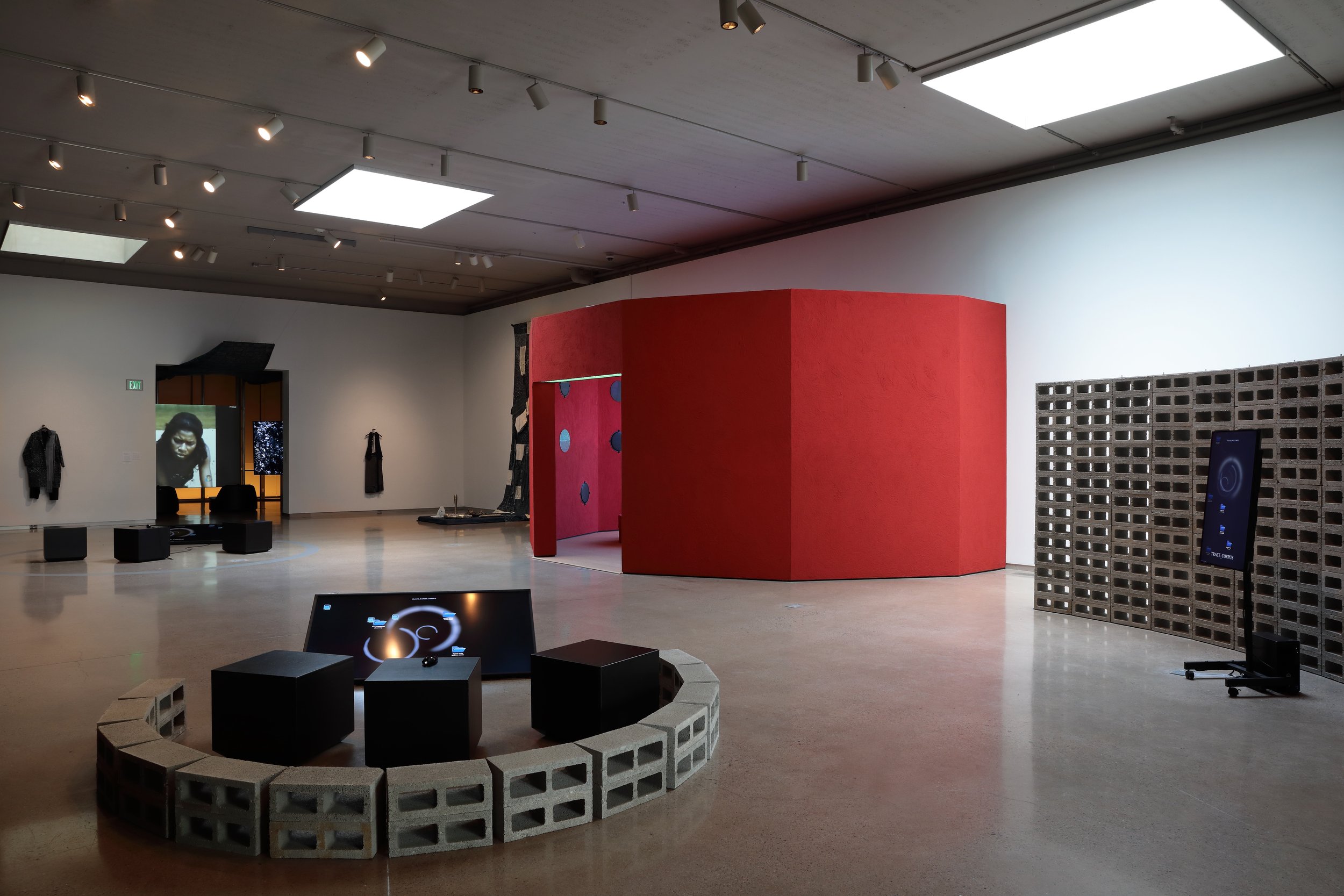
In the pavilion’s interior space, Dennis presented a new interactive digital essay-game, Black Earth Corpus. The work invited visitors to engage multiple forms of collectively gathered media relating to the themes of Traces of Ecstasy. Viewers navigated a series of semipermeable virtual chambers with a joystick, moving through different parts of a shape-shifting archive of text, video, and image fragments. As a browser providing virtual portals to an archive of black, indigenous, queer liberation, the work speculates on the possibilities and limitations of online refuges and digital sovereign spaces for historically oppressed groups.

Nolan Oswald Dennis, Black Earth Corpus, 2024. Monitor, joystick, local server. Dimensions variable. Photograph by Amanda Iheme.

Traces of Ecstasy Pavilion, Lagos Biennial 2024, installation view. Photograph by Amanda Iheme.
Nearby, Shonibare’s three-channel video installation wove together seemingly disparate audio and visual media to explore a multiplicity of cultural sites enshrined in the Nigerian and Afro-diasporic collective imaginary, from the colonial period, to the immediate post-independence era, to the present Fourth Republic. Adopting the disjunctive visual grammar of social media platforms, the work delivers a satirical critique of contemporary Nigeria’s neocolonial and anti-queer religious, economic, and state institutions. Foregrounding media spectacle and incorporating glitchy effects, CGI renderings, and Nollywood aesthetics, the work articulates uncanny gestural continuities between video recordings of Pentecostal church services, military parades, voguing ballrooms, and the ENDSARS protests of 2020. Through these playful juxtapositions, humorous subversions, and rhythmical narrative diversions, the work reflects on the commingling of physical and online spaces as well as the scrambled, digitized subjectivities produced under twenty-first-century neoliberal capitalism.

Temitayo Shonibare, By Divine Decree!!, 2024. Three-channel video (colour and sound). Photograph by Amanda Iheme.

Temitayo Shonibare, By Divine Decree!!, 2024. Three-channel video (colour and sound). Photograph by Amanda Iheme.

Temitayo Shonibare, By Divine Decree!!, 2024. Three-channel video (colour and sound). Photograph by Amanda Iheme.
Choreographed with the materiality of the pavilion and its historical location in mind, and in collaboration with sound artists Ayomide Kalejaiye (SAROSAYÉ) and Xavier Emmanuel, Pinto’s roving live performance (held on February 4th, 2024 at 4pm) took the Gẹlẹdẹ masquerade as its starting exploratory point—a masquerade ritually performed by male-gendered persons in honour of female deities and ancestors. Wearing garments and objects specially designed by Thompson, Pinto imaginatively deconstructed and retooled these indigenous ritualistic performances and merged them with popular, avant-garde, and black diasporic archives of movement—voguing, hip-hop, ballet, minimalism, and digitally viral contemporary African dances—to illuminate decolonial registers of queer embodiment.

Raymond Pinto, diffractions, 2024. Performance in collaboration with SAROSAYÉ, Xavier Emmanuel, and Lagos Space Programme. Photo by Wami Aluko.

Raymond Pinto, diffractions, 2024. Performance in collaboration with SAROSAYÉ, Xavier Emmanuel, and Lagos Space Programme. Photo by Wami Aluko.

Raymond Pinto, diffractions, 2024. Performance in collaboration with SAROSAYÉ, Xavier Emmanuel, and Lagos Space Programme. Photo by Wami Aluko.

Raymond Pinto, diffractions, 2024. Performance in collaboration with SAROSAYÉ, Xavier Emmanuel, and Lagos Space Programme. Photo by Wami Aluko.