Traces of Ecstasy | ICA at VCU | Checklist & Descriptions

Checklist & Descriptions | Traces of Ecstasy | Institute for Contemporary Art at Virginia Commonwealth University
Nolan Oswald Dennis
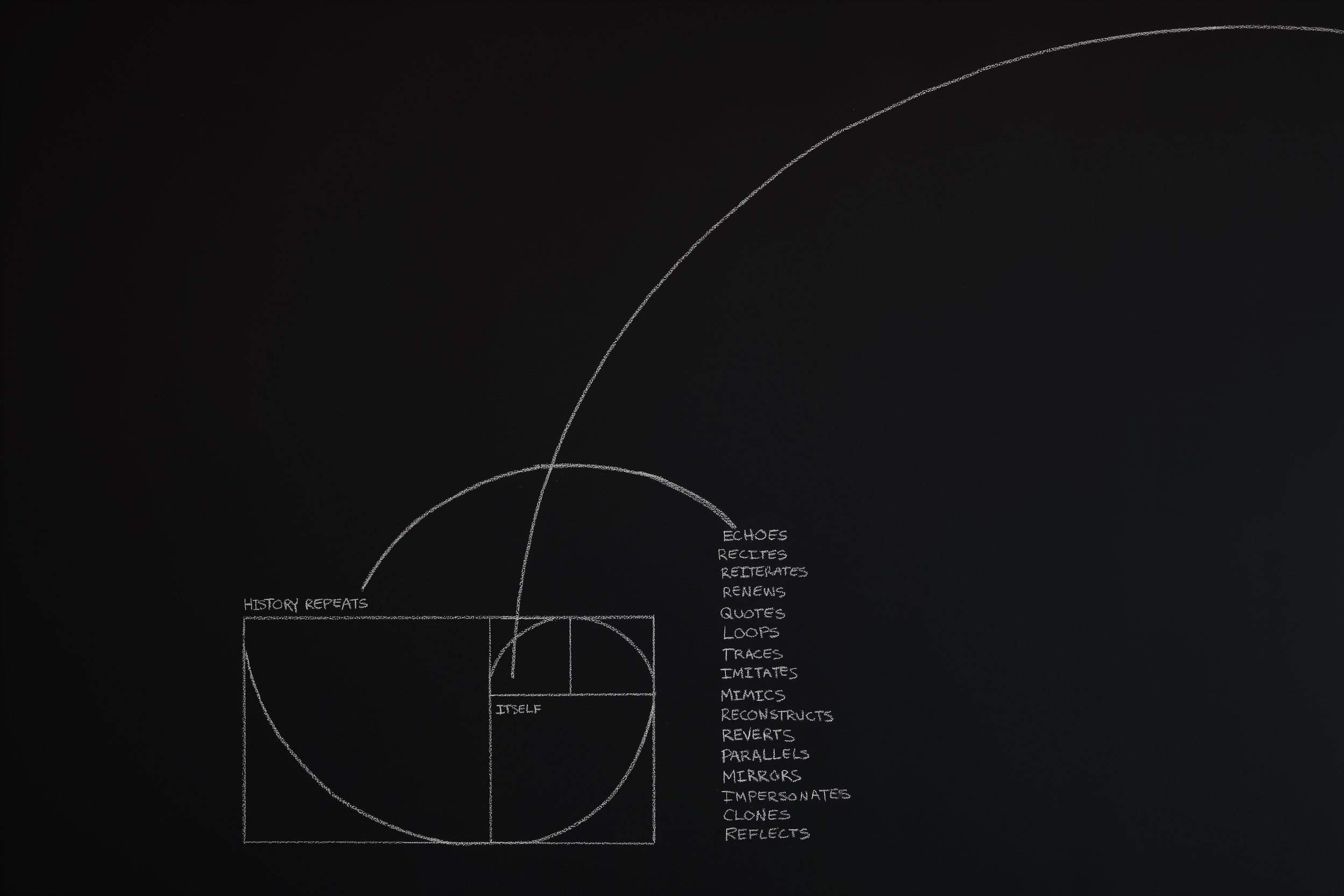
Options, 2018
Chalk on black wall
Dimensions variable
The staff at the ICA at VCU realized this site-specific work according to artist Nolan Oswald Dennis's detailed instructions. The piece cites an 1869 essay by Karl Marx, in which he writes, “Hegel remarks somewhere that all great world-historic facts and personages appear, so to speak, twice. He forgot to add: the first time as tragedy, the second time as farce.” In Options, Marx’s words are broken up with wide spaces and connected by mathematically defined curves that correspond to the arm length of the artwork’s installer. Written in chalk on a matte black wall—a reference to spaces of rote, disciplinary instruction as well as liberatory, collective pedagogy—the paraphrase “SECOND AS FARCE” has been crossed out and replaced with “SECOND AS STRATEGY.” Through these gestures, Dennis reflects on history’s spiral repetitions and fractal patterning. The lists of synonyms under “REPEATS,” “TRAGEDY,” and “STRATEGY” allude both to the repetitional algorithmic logic of a computer word generator and the accumulating weight of lingering pasts and alternative futures.


Nolan Oswald Dennis
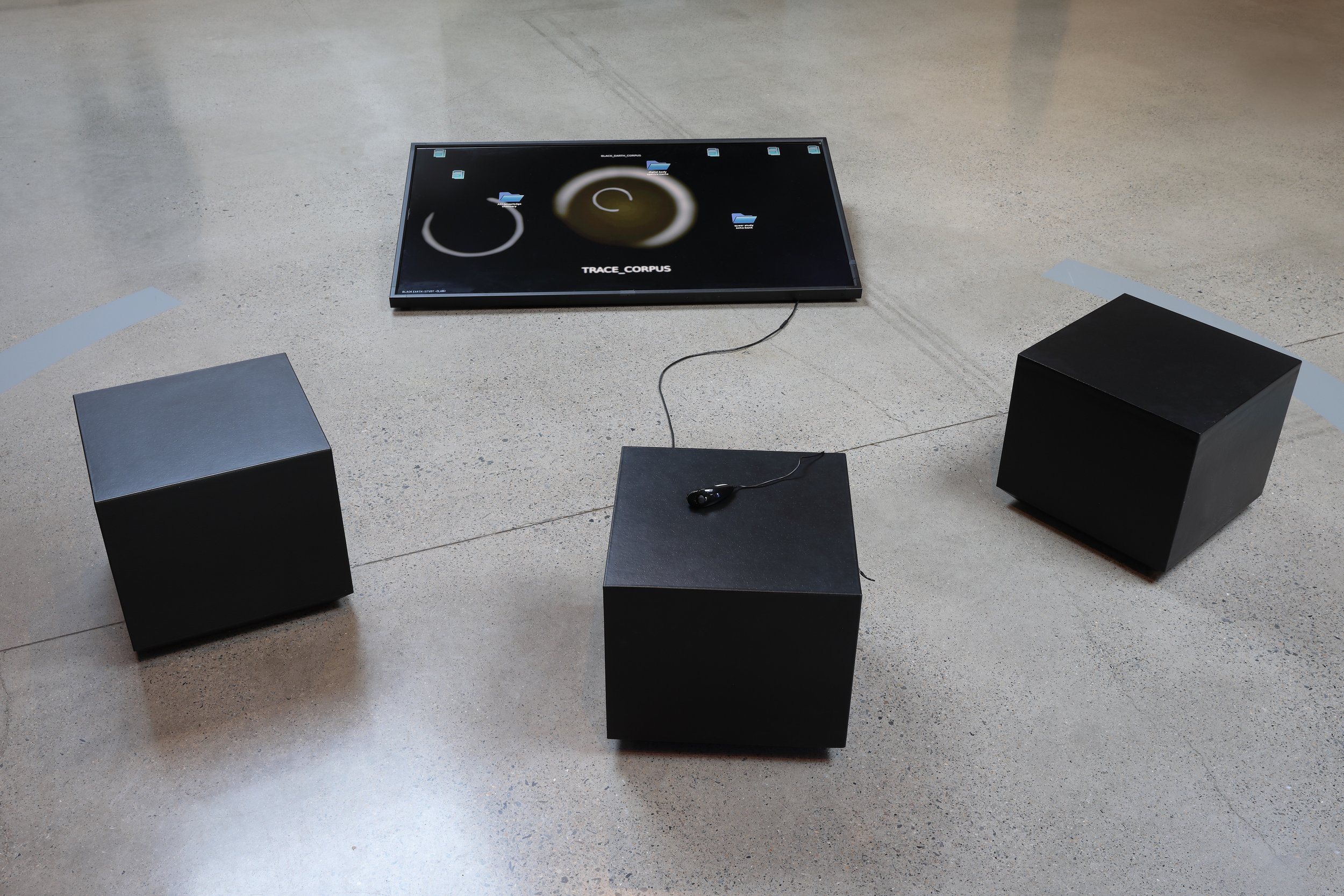
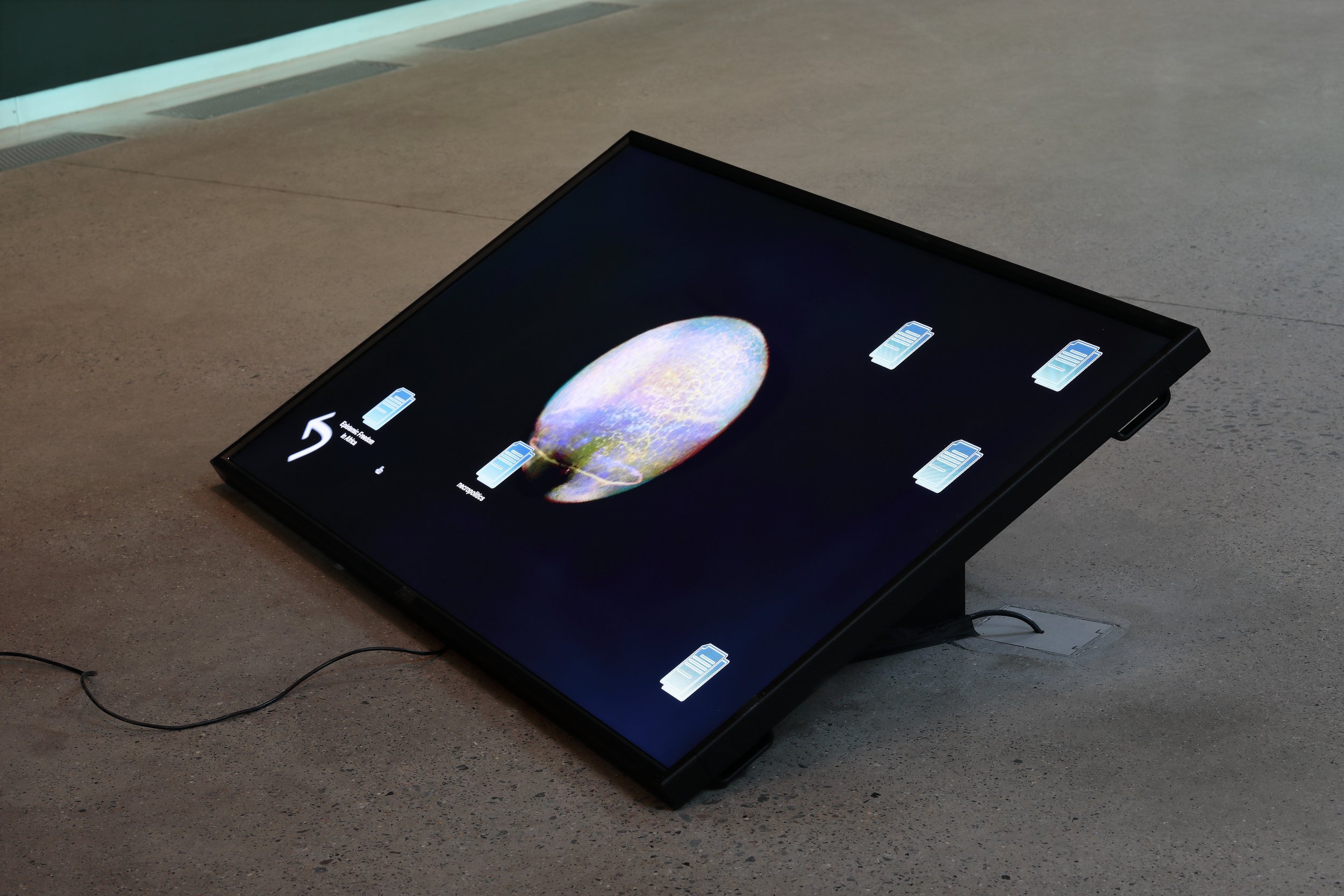
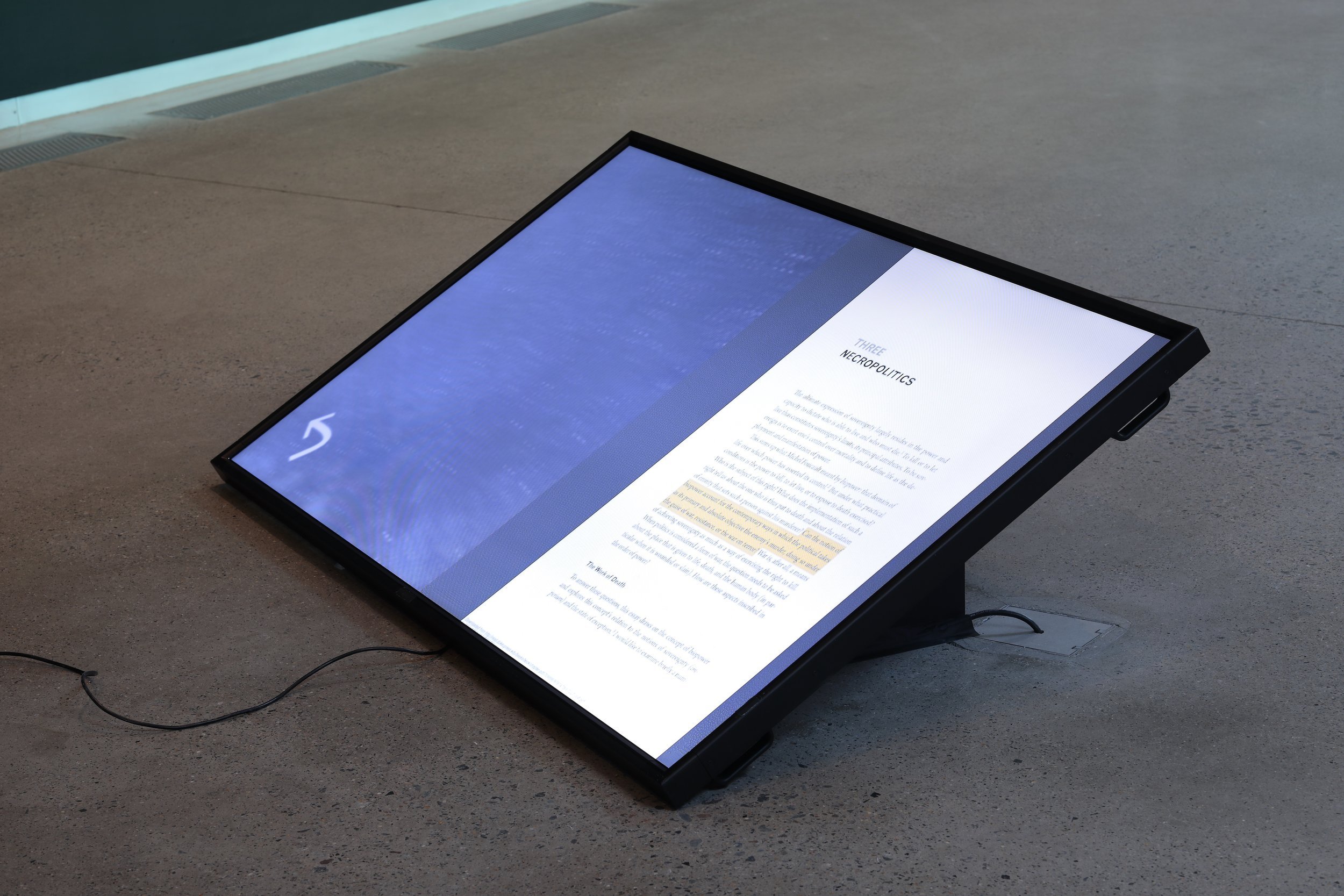
Black Earth Corpus, 2024
Three monitors, two joysticks, local server
Dimensions variable
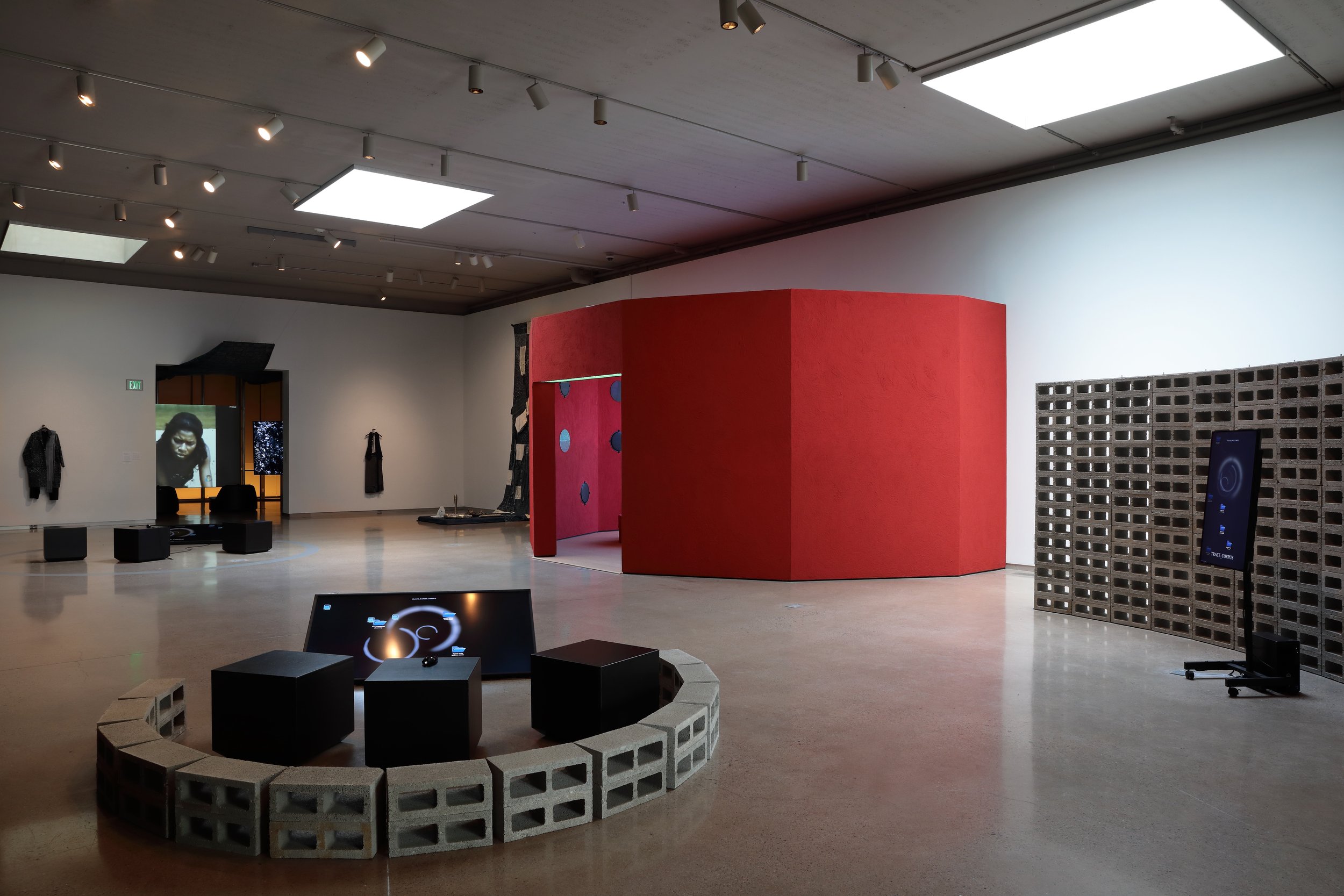
Accessible at three locations in the gallery, this networked and interactive digital essay-game invited visitors to engage multiple forms of collectively gathered media relating to the themes of Traces of Ecstasy. Viewers navigated a series of semi-permeable virtual chambers with a joystick, moving through different parts of a shape-shifting archive of text, video, and image fragments. As a browser providing virtual portals to an archive of black, indigenous, queer liberation, the work speculates on the possibilities and limitations of online refuges and digital sovereign spaces for historically oppressed groups.

Nolan Oswald Dennis
trace xa, 2023
Exposed steel frame and concrete bricks
Nolan Oswald Dennis
trace xb, 2023
Concrete bricks
Nolan Oswald Dennis
trace xc, 2023
Vinyl
This grouping of architectonic sculptures is based on the pavilion built for the 2024 Lagos Biennial. Prompted by this exhibition’s title, Dennis thought through ideas of “traces” and “tracing,” and, relatedly, on the linguistic and philosophical relationships between nouns and verbs, between being and becoming. Each of the sculptures embodies haunted architectural traces of the pavilion’s modeled facades through their fragmented material reconstitution, across the Atlantic Ocean, in Richmond, Virginia. Viewed together, the sculptures also perform a tracing sequence, beginning with the full-height facade (trace xa), which decomposes into a singular row of bricks (trace xb), and further again into a flat tracing on the ground (trace xc), inviting an associative correspondence in the relations between actuality and virtuality, and that of the African continent to its diasporas. The placement of these structures adjacent to a reading room and Black Earth Corpus created spaces of refuge for visitors—a guiding theme of the 2024 Lagos Biennial. The repetition of the curvilinear forms references the recursive, fractal geometries of indigenous African architecture, while the alignment of concrete bricks into a breeze-block pattern alludes to postcolonial modernist buildings constructed during mid-twentieth-century African decolonization movements.


Evan Ifekoya
Three States of Water: The Flood, 2023
Sound installation (multi-channel sound), speakers, wood, acrylic glass, LED stripes, cork, mirrors, dichroic foil
Dimensions variable
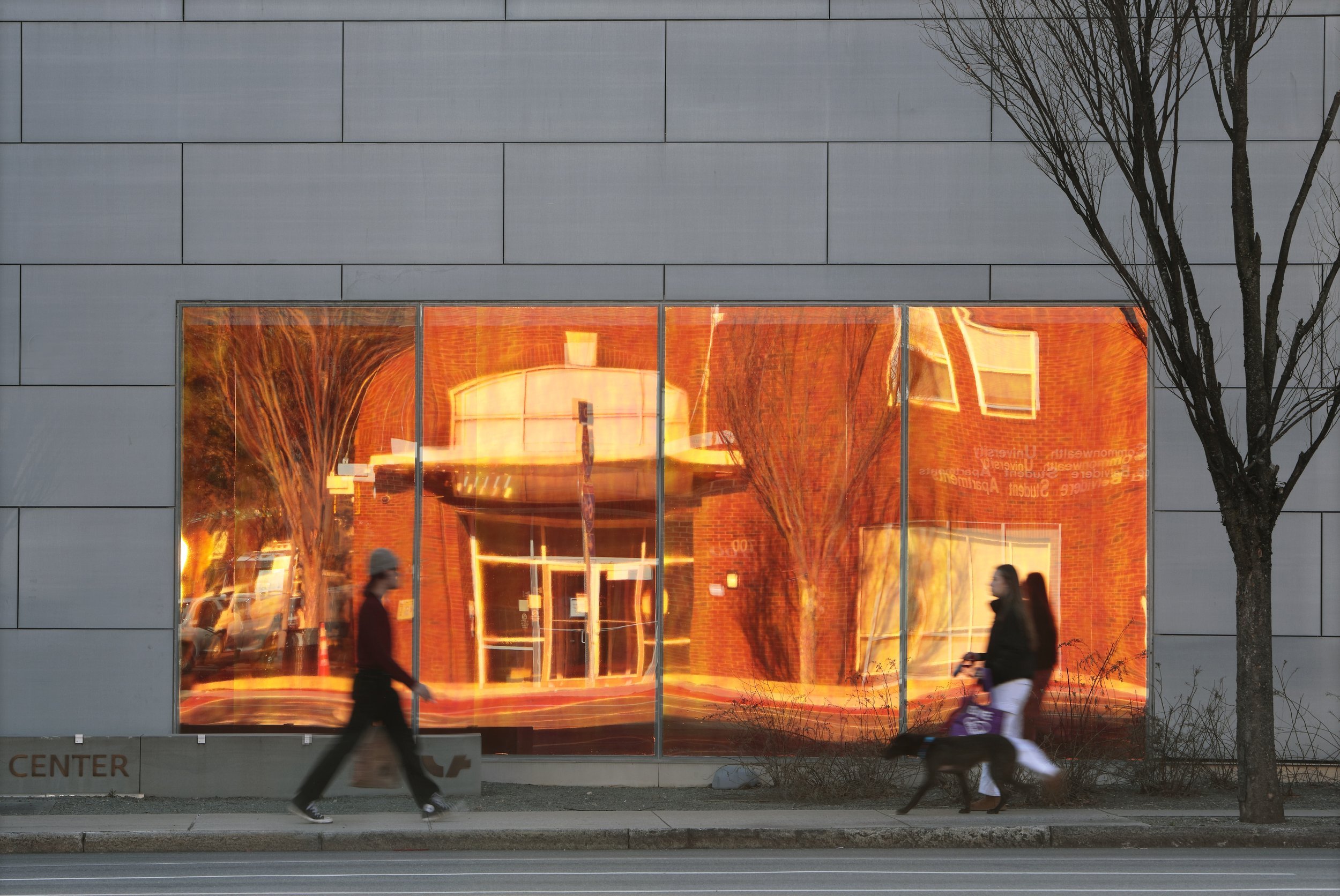
Evan Ifekoya’s monumental installation explores the reparative and knowledge-producing capacities of sound. Incorporating sounds of water undergoing various state changes, the work metaphorically speculates on the melting, liquefaction, and sublimation of the postcolonial nation-state. The poeticization of water’s resistance to material and geographical fixity further alludes to queer modalities that destabilize structures of national, gender, sexual, and ethnic identification. Ifekoya’s immersive sound score also includes speeches by Tafawa Abubakar Balewa (Nigeria’s first and only prime minister), Yoruba polyrhythmic drumming, social commentary on the current state of things by working-class Nigerians, and the artist’s self-spoken narrations on healing and self-knowing through travels to the Atlantic shore in Badagry and the sacred Osun grove in Osogbo. Housed in a semi-hexagonal structure, Ifekoya’s installation, akin to Dennis’s sculptures, referenced the curvilinear geometries found in indigenous African architecture. The ocher plaster walls evoked the reddened earth present in many regions of West Africa (which are often used in vernacular mud architecture) and also in the southern United States. Forming an intimate refuge for visitors, Three States of Water employed not only the reparative frequencies of sound but also those of light, with atmospheric lighting and surface-reflective window tints that changed color over the course of the day.


Adeju Thompson/Lagos Space Programme
Aerial Proposition I (Post-àdìrẹ), 2024
Indigo-dyed cotton canvas, indigo-dyed silk, indigo-dyed cotton, cotton canvas with cassava paste, indigo-dyed vintage aṣọ-óké
Aerial Proposition II (Post-àdìrẹ), 2024
Indigo-dyed chiffon, indigo-dyed wool, indigo-dyed cotton canvas, indigo-dyed heavyweight cotton jersey
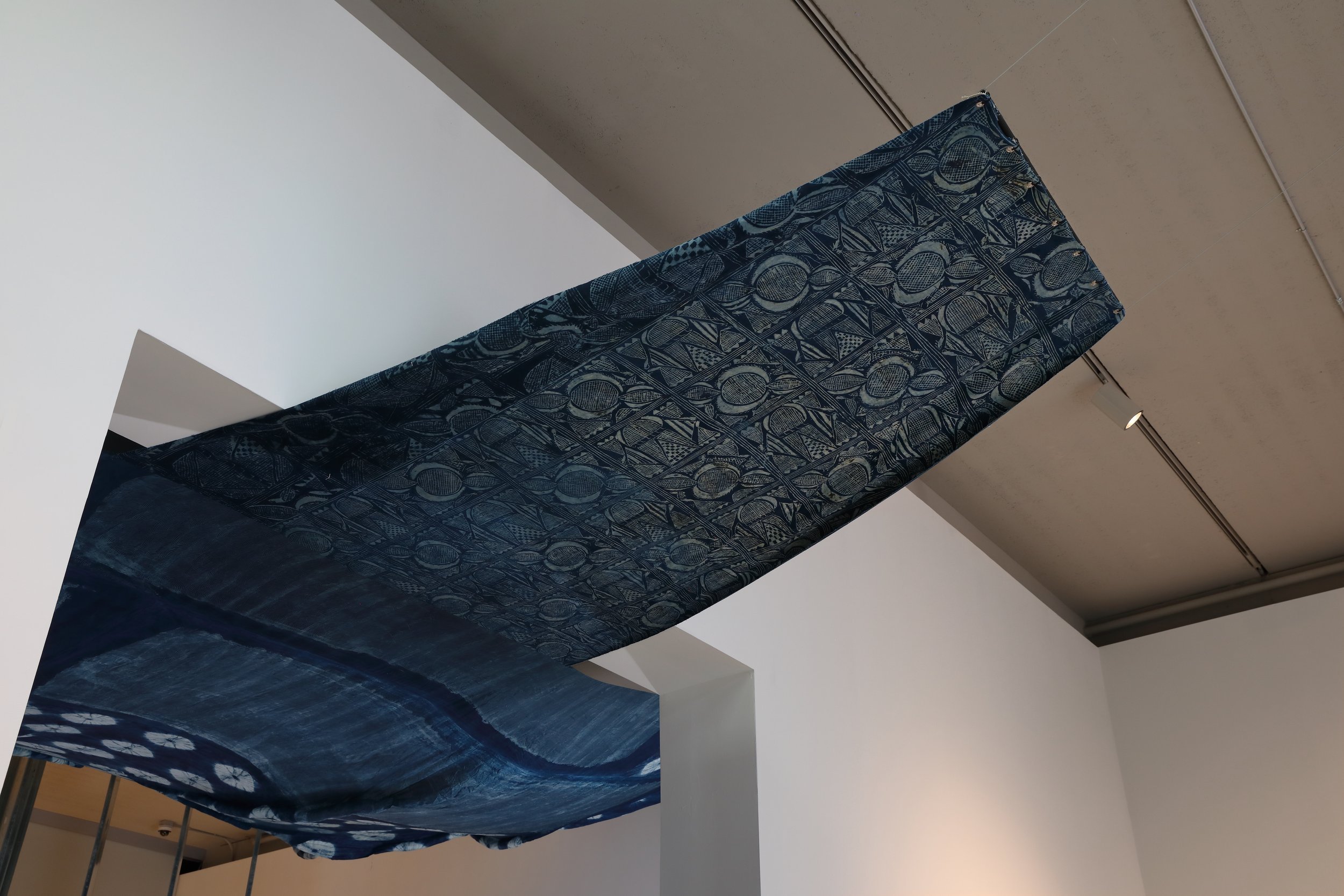
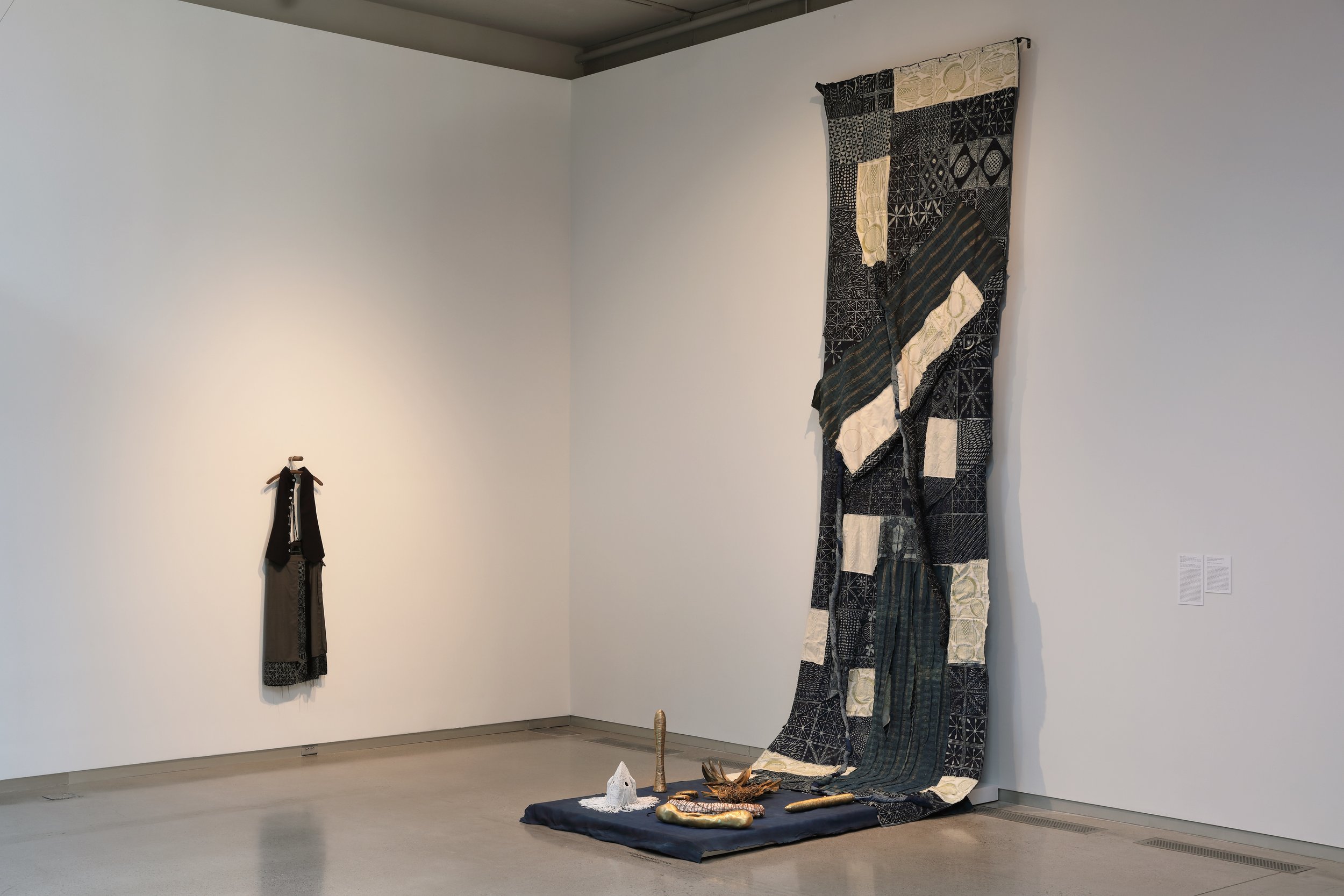
Thompson played with monumental scale in these suspended works, continuing their ongoing research into reanimating Yoruba clothing styles and textile practices in a twenty-first century context. Since the founding of their experimental, gender-expansive fashion label, Lagos Space Programme, Thompson has specifically taken to àdìrẹ—a resist indigo-dyeing technique long practiced by the Yoruba in what is today southwestern Nigeria. Coining the term “post-àdìrẹ” to categorize their formal innovations within this indigenous textile tradition, Thompson scales up their technical and conceptual concerns in these pieces, which were both created in collaboration with women artisans in the city of Abeokuta. The pieces collage àdìrẹ cloths with various other fabrics such as vintage aṣọ-óké (a revered loom-woven Yoruba textile composed of silk and cotton strips with patterned perforations) and undyed cotton patches bearing patterns made of cassava paste (the resist substance used in an earlier stage of the dyeing process). Thompson also rips, tears, and folds the works’ surfaces, these violent gestures suggesting the scarred, brutalized skin of the postcolonial African body politic. Further evoking market tarps and ephemeral architectures for refuge, these indigo-dyed sculptures provide a sense of protection and communal gathering for the viewer’s body, while their alternating abstract and botanical patterns preserve the historically communicative capacities of West African textiles.
Adeju Thompson/Lagos Space Programme
Look I (Project 5: Aṣọ Lànkí, Kí Ató Ki Èniyàn/We Greet Dress Before We Greet Its Wearer), 2023
Àdìrẹ coat, shirt, trousers, beaded scarf
Look II (Project 5: Aṣọ Lànkí, Kí Ató Ki Èniyàn/We Greet Dress Before We Greet Its Wearer), 2023
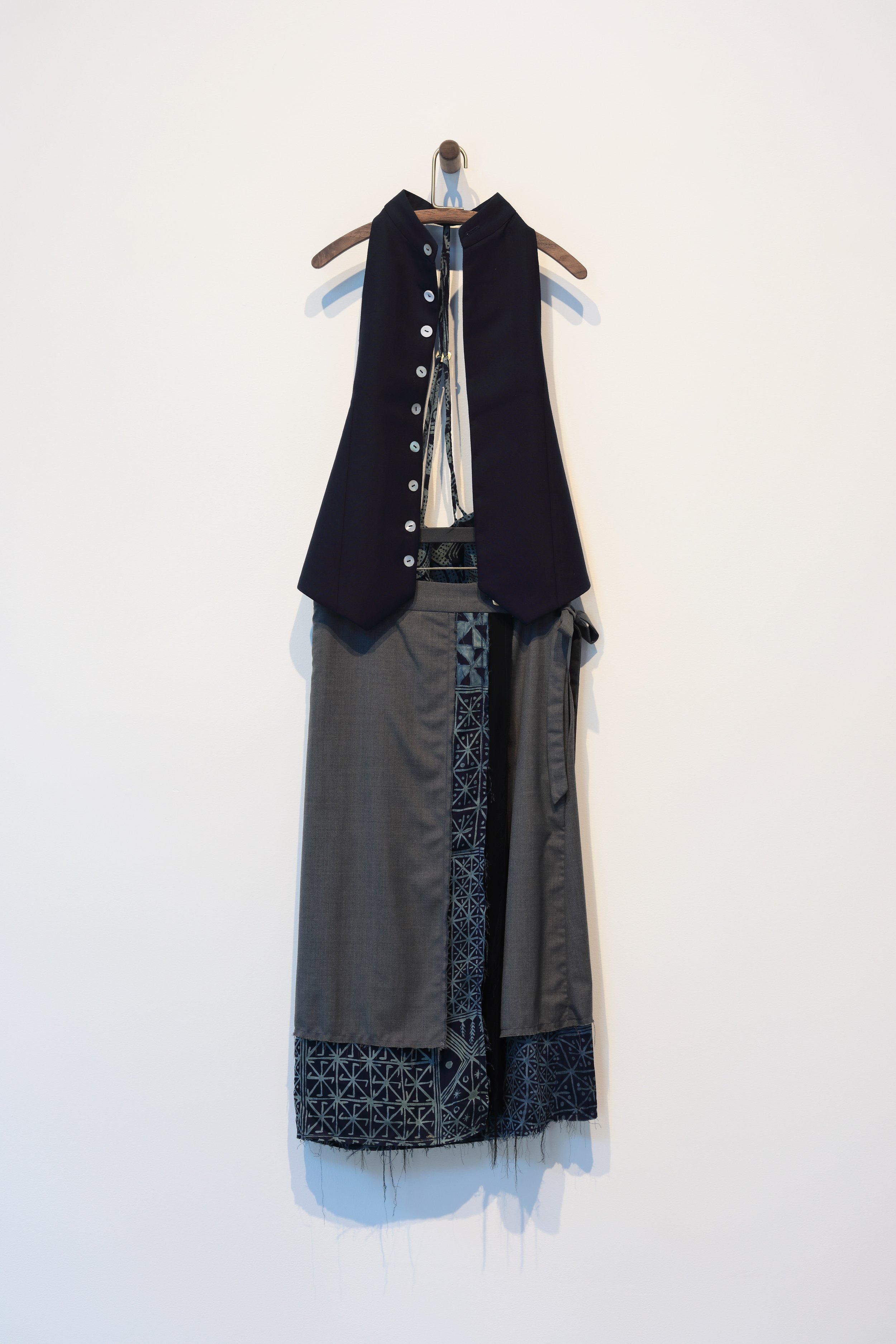
Vest, skirt, bronze anklets, beaded veil headpiece
These two outfits are an extension of Adeju Thompson’s experimental fashion label, Lagos Space Programme, founded in 2018. Here, Thompson continues their formal innovations and queer resignifications of the Yoruba sartorial archive. Comprised of an ornately beaded headpiece, chiming metallic anklets, and volumetric, indigo-dyed tops and bottoms, these outfits are connected to Thompson’s Project 5 collection of 2021, which took inspiration from the Gẹlẹdẹ masquerade. This masquerade is ritually performed by male-gendered persons in honor of female deities and ancestors. Because masquerades are understood by the Yoruba to be ephemeral yet literal embodiments of the spiritual world, they have strategically been interpreted here as modeling indigenous modes of gender-queer performance. These outfits were worn and activated by the artist Raymond Pinto during his movement-led performances. By making these pieces available for performative use, the exhibition sought to destabilize the violently inert and decontextualized presentation of African cultural objects in (Western) art institutions, alternatively resituating them within relation-centered economies of motion.

Adeju Thompson/Lagos Space Programme
Frot Interludes: A Devotee Conspiracy, 2023
Bronze, clay, metal wiring
Orchid (Osun Sèègèsi/Project 6), 2021
Bronze
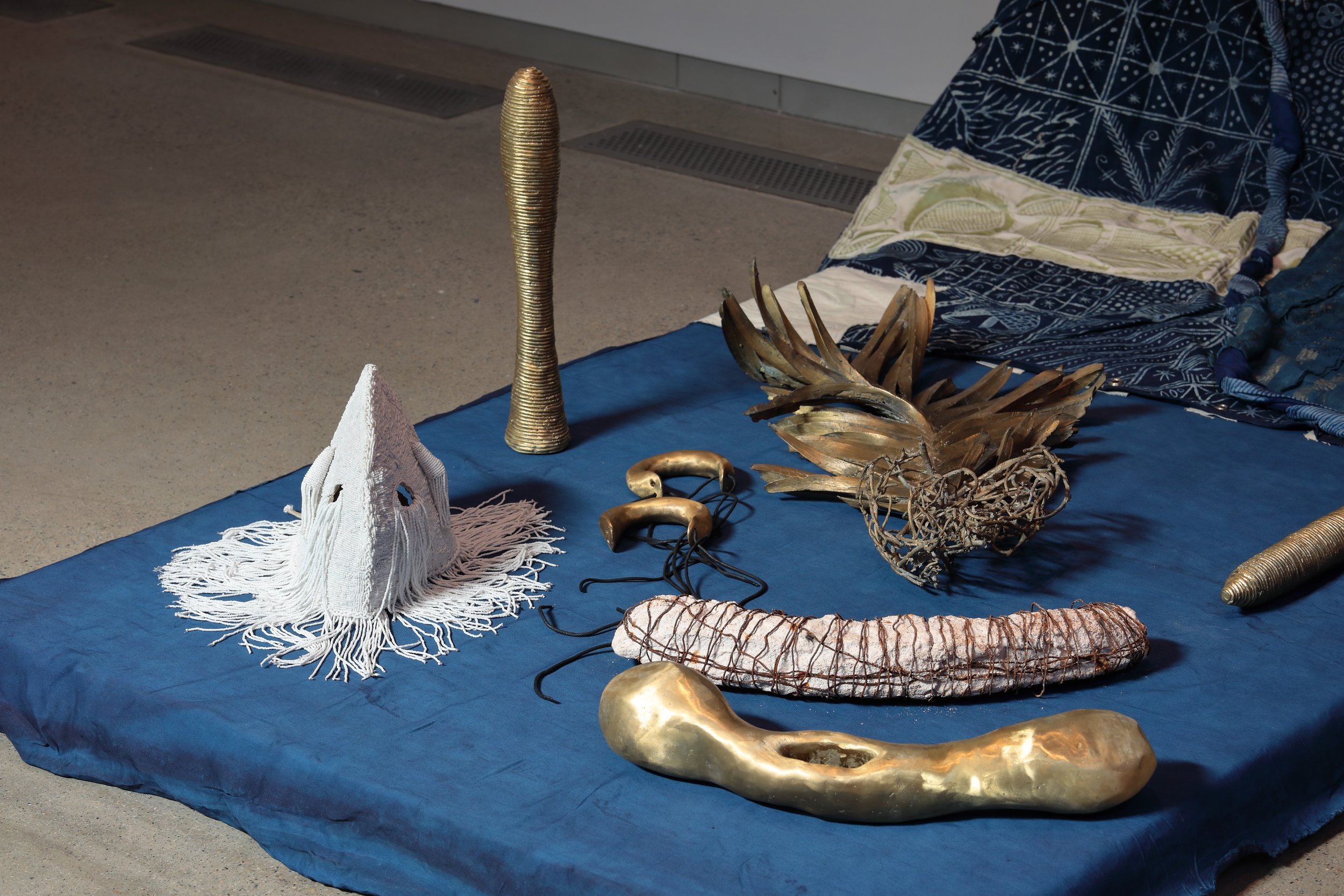
These bronze objects are critical interpretations of the centuries-long practice of bronze casting in Benin, located in what is today southern Nigeria. Thompson collaborated with artisans in Benin to make these pieces, using the revered centuries-old lost-wax process. This meticulous process involves casting a sculptural mold in wax, which is then encased in clay, emptied out through melting (forming a negative clay mold), and finally filled with molten metal. After a period of cooling, the bronze sculpture gradually comes into view as the artisan chips away at the hardened clay covering. Fascinated by the alchemy of this process, Thompson left one of the objects still covered in clay. Another piece, sculpted from an orchid, stems from Thompson’s ongoing research on local botanical cultures. Other pieces subtly reference Yoruba regal scepters and phallic forms—the former, a spiritual source of the universe’s animating life force (what the Yoruba call àṣẹ), and the latter, an ecstatic site of the queer erotic.
Raymond Pinto
within a reverie, 2024
Performance, video.
mirror worlds, 2024
Performance, super 8mm film transferred to video, sound, dried palm leaves, Gẹlẹdẹ masks
In collaboration with Dale Ratcliff.
Throughout the duration of Traces of Ecstasy, Pinto led a series of choreographed live performances, taking the movements and adornments of the Gẹlẹdẹ masquerade as a point of departure. Wearing garments and objects specially designed by Thompson, Pinto imaginatively deconstructed and retooled these indigenous ritualistic performances and merged them with popular, avant-garde, and black diasporic archives of movement—voguing, hip-hop, ballet, minimalism, and digitally viral contemporary African dances—to illuminate decolonial registers of queer embodiment. Pinto also incorporated sound and musical elements, ranging from techno to Yoruba polyrhythmic drumming and spoken word. This sonic collage, at times paired with filmic footage produced during Pinto’s visits to Lagos, expresses the aliveness and multidimensionality of the queer African diaspora, past, present, and future. Pinto’s performances occurred on February 16 and March 29, 2024 at the ICA at VCU.


Temitayo Shonibare
By Divine Decree!!, 2024
Three-channel video (color and sound), steel studs, wireless headphones
15:00
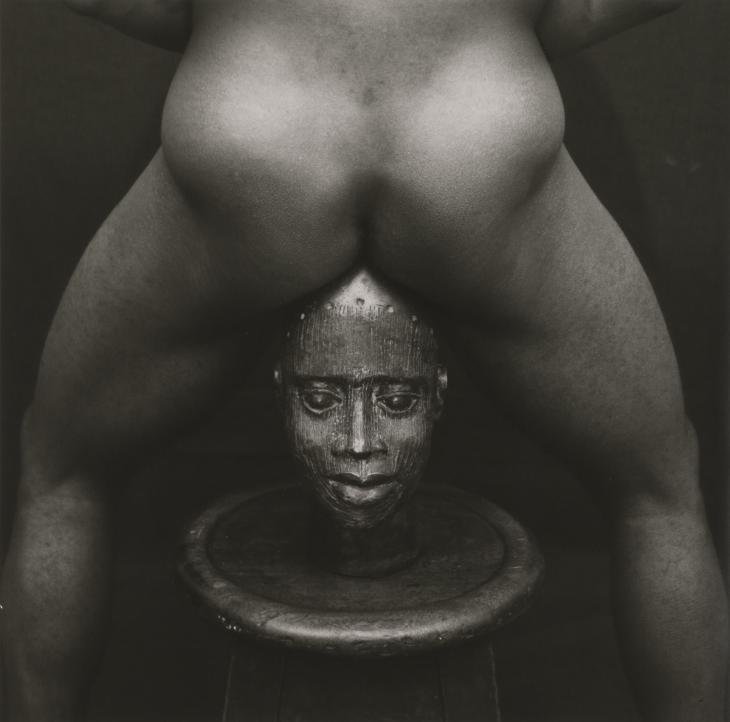
In this multichannel video installation, Shonibare weaves together seemingly disparate audio and visual media to articulate spatial, cultural, and performative dissonances and continuities between Nigeria’s colonial period, the immediate post-independence era, and the present Fourth Republic. Employing a lyrical approach that foregoes didacticism and linear storytelling to embrace playfulness, humor, and rhythm, the work delivers a satirical critique of Nigeria’s neo-colonial and anti-queer religious, economic, and state institutions. Shonibare’s disjunctive editing style—informed by the logic of social media platforms—subverts the dominant cultural encodings of audiovisual sites enshrined in the Nigerian and Afro-diasporic collective imaginary. The work, for instance, contrasts archival footage of televised Nigerian Pentecostal church services with scenes from local military parades, black voguing ballrooms in the United States, and the ENDSARS protests of 2020, underscoring the uncanny continuities of camp and ecstatic performance underpinning these varied social settings. Another sequence juxtaposes photographs by exiled British-Nigerian queer photographer Rotimi Fani-Kayode with images of Tafawa Balewa on a diplomatic visit to the United States in 1961, shortly after Nigeria achieved independence. Foregrounding media spectacle and gesture, and incorporating glitchy effects, Nollywood aesthetics, and CGI renderings, the work’s multiple narrative diversions reflect the contemporary commingling of physical and online spaces as well as the scrambled, digitized subjectivities produced under twenty-first-century techno-capitalism.